-
 FIND USHIGH-TECH ZONE
-
 CALL US TODAY
-
 EMAIL US NOW
When precision machinery operates in harsh environments, the vulnerability of guide rails and moving cables often becomes the primary cause of unplanned downtime. Contaminants like metal chips, coolant spray, and industrial dust can rapidly degrade critical components, leading to increased friction and premature wear.
The technical challenge lies in balancing total enclosure with the flexibility required for reciprocating motion. While rigid covers provide maximum protection, they lack the adaptability needed for dynamic axes, creating a demand for specialized flexible shielding solutions.
Finding a reliable bellow cover manufacturer involves evaluating not just the material used, but the engineering logic behind the fold and the durability of the reinforced polymers.


Protective bellows act as the first line of defense for machine tools. By creating a sealed environment around the linear guide and ball screw, they prevent abrasive particles from entering the lubricant film. This prevents the "scoring" effect where microscopic debris acts as a grinding agent on precision surfaces.
Beyond mere debris protection, these covers manage the containment of lubricants, ensuring that oil remains on the rail rather than dripping into the machine bed, which reduces cleanup time and prevents environmental contamination.
A high-performance bellow must satisfy three conflicting requirements: maximum expansion, minimum compression volume, and high fatigue resistance. If the bellows are too stiff, they increase the load on the motor; if they are too loose, they may sag and become caught in the moving machinery.
Precision in the fold geometry is critical. Poorly designed folds create stress concentrations that lead to premature cracking. Professional engineering involves calculating the exact pitch and radius to ensure that the material distributes tension evenly across its surface during every cycle of the reciprocating motion.
Furthermore, the attachment method—whether using clamping plates or adhesive bonding—must be airtight. A failure at the seal point renders the entire protective system ineffective, as contaminants will simply enter through the gaps at the ends of the bellow.
The choice of polymer defines the operational lifespan of the cover. In the machinery sector, reinforced Polyamide (PA) is preferred over simple PVC or rubber due to its superior dimensional stability and resistance to industrial chemicals.
The use of original, virgin nylon raw materials is non-negotiable for high-cycle applications; recycled nylon lacks the molecular chain strength required to withstand millions of compression cycles without brittle failure.
PA6 offers slightly better impact resistance and flexibility, making it suitable for bellows that undergo extreme deformation. PA66, however, provides higher thermal stability and mechanical strength, which is essential for environments where temperature fluctuations range from -40 to 130 ℃.
Evaluating a protective system requires looking at the "Wear Index" and "Torsional Stability." A quality bellow should maintain its shape even when the axis moves at high speeds, avoiding the "ballooning" effect that can interfere with other machine components.
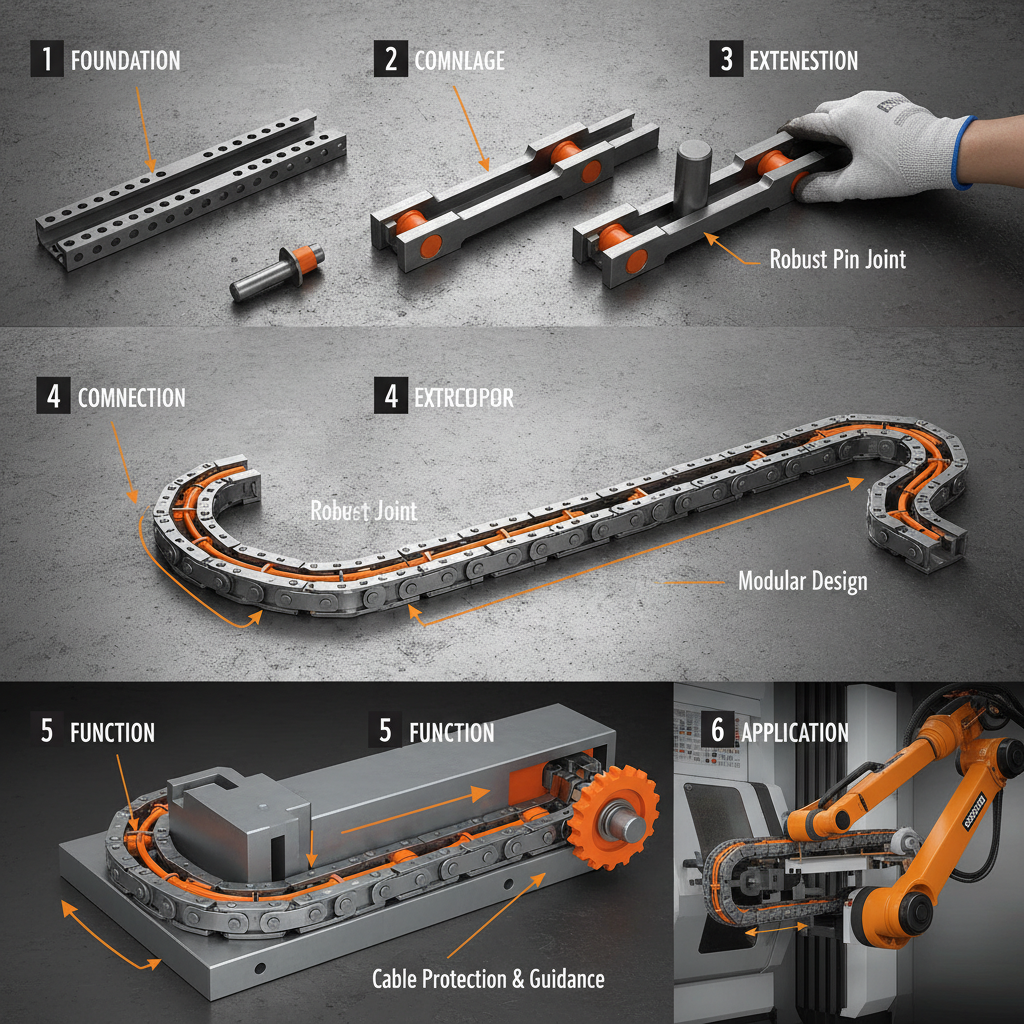
When comparing materials, the focus shifts to how physical properties correlate with actual downtime. Reinforced nylon, particularly when used in cable carriers and bellow pipes, demonstrates a significantly lower degradation rate compared to standard plastics.
In CNC milling centers, the most common failure point is the "bottom fold" of the bellow, where heavy metal chips accumulate and eventually puncture the material. To mitigate this, manufacturers are increasingly implementing "chip-shedding" geometries that allow debris to slide off the cover rather than resting on it.
Another critical scenario is high-speed reciprocating motion. In these cases, the air trapped inside the bellow can create a pneumatic cushion that resists movement. The integration of ventilation holes or specialized porous materials is often required to maintain precision without sacrificing protection.
Standardized sizes are often insufficient for complex machinery. Modern production flows now emphasize the creation of custom moulds based on the specific inner dimensions (Height x Width) and radius of the machine's travel.
The transition toward "Modular Protection" allows for easier maintenance. Instead of replacing an entire cover system, technicians can now replace specific sections or segments of the bellows, significantly reducing the cost of ownership over the machine's lifecycle.
As a specialist in this field, Shijiazhuang Agile company leverages over 13 years of experience to refine these structures. By incorporating customer feedback on wear patterns, they continuously adjust mould designs to improve functional performance and extend the intervals between replacements.
When sourcing from a bellow cover manufacturer, the primary focus should be on the balance between raw material quality and geometrical precision. A lower price often indicates the use of recycled plastics, which possess inferior physical performance and a higher probability of stress-cracking.
Engineers should verify the operating temperature range and the recommended gap (typically around 10%) to ensure the bellows do not bind during operation. Compatibility with standards such as DIN, ISO, and JIS ensures that the components integrate seamlessly with global machinery brands.
The following framework provides a comparative look at how different selection factors impact the overall performance of the shielding system in a typical industrial setting.
| Evaluation Factor | High-End Requirement | Standard Requirement | Risk of Low-End Choice |
|---|---|---|---|
| Material Grade | Virgin PA66 Reinforced | Standard PA6 | Brittle failure from recycled resin |
| Temperature Limit | -40℃ to +130℃ | -20℃ to +80℃ | Thermal warping/melting |
| Cycle Life | > 5 Million Cycles | 1-2 Million Cycles | Rapid fold fatigue/tearing |
| Fitment Precision | Custom Moulding | Standard Sizes | Material sagging or binding |
| Chemical Resistance | Oil & Coolant Proof | Basic Oil Resistance | Polymer degradation/softening |
| Maintenance Ease | Modular Replacement | Full Unit Replacement | Excessive machine downtime |
PA6 (Polyamide 6) generally offers better impact resistance and higher flexibility, which is ideal for bellows undergoing extreme compression. PA66 (Polyamide 66) provides superior mechanical strength and higher thermal stability, making it more suitable for high-temperature environments and applications requiring greater rigidity and wear resistance. The choice depends on whether the priority is elasticity or thermal durability.
Recycled nylon has shorter molecular chains and often contains impurities from previous use, which significantly reduces its fatigue strength. In reciprocating motion applications, this manifests as "stress whitening" and premature cracking at the fold points. Virgin nylon maintains consistent physical properties, ensuring the cover can withstand millions of cycles without structural failure.
Yes, professional manufacturers utilize a variety of existing moulds but can develop new, custom moulds for special requirements. Customization usually involves adjusting the inner height and width, as well as the bend radius, to ensure a perfect fit that prevents the material from sagging or rubbing against the machine frame, which is critical for maintaining high-speed precision.
The most critical signs include visible punctures, longitudinal cracks along the folds, or a loss of tension where the cover begins to sag. Additionally, if you notice an increase in debris on the guide rails or a decrease in lubricant effectiveness, it suggests the seals have failed. Replacing them immediately prevents costly damage to the precision rails and ball screws.
The recommended gap (typically 10%) is the extra space allowed within the cover or carrier to prevent the internal cables or components from being pinched during bending. If the gap is too small, the cables will experience excessive friction and internal wear. If it is too large, the cables may shift and tangle. This is calculated based on the bend radius and the outer diameter of the protected elements.
While standard reinforced nylon is not entirely "fireproof" in the sense of being impervious to all fire, it is often treated to be flame-retardant or self-extinguishing. This means it will not support combustion and will stop burning once the heat source is removed, which is a critical safety requirement for machinery operating near high-heat zones or electrical components.
The longevity of precision machinery is inextricably linked to the quality of its protective systems. Moving beyond simple covers to engineered solutions—utilizing virgin reinforced nylon and precision fold geometries—transforms a consumable part into a strategic asset that reduces downtime and extends the life of expensive guide rails.
For procurement and engineering teams, the key is to prioritize material integrity and custom fit over initial cost. A robust partnership with an experienced manufacturer ensures that protection systems evolve alongside the machinery, providing a sustainable solution for high-performance industrial environments.